





A catastrophic injury impacts your life twice: first as the medical emergency, then as the financial one.
While your family is still in the hospital waiting room, the at-fault driver’s insurer is already building its file. The adjuster who calls within days is trained to lock in a recorded statement and a fast, low number before anyone knows what lifetime care will cost.
If you or a loved one suffered a catastrophic injury in an accident in Baltimore, you may be entitled to recover compensation for your medical bills, the pain and suffering you have endured, your past and future lost earnings, and the lifetime cost of care your injury will require. Maryland catastrophic injury settlements should account for future care, lost income, and lifelong changes.
Contact our Baltimore, Maryland law office to set up a free case evaluation, or call (410) 837-2144 to speak with an experienced Baltimore catastrophic injury lawyer from WGK Personal Injury Lawyers.
Maryland has its own rules for fault, damages, and insurance, and those rules can hit the most seriously injured clients the hardest. An experienced Baltimore catastrophic injury lawyer at WGK Personal Injury Lawyers can make sure your claim is documented correctly and built to pursue the compensation Maryland law entitles you to seek for your losses.
Table of Contents
What Is a Catastrophic Injury?
A catastrophic injury is one that permanently changes the way a person can live, work, or care for themselves. Federal law defines a catastrophic injury as one that "permanently renders an individual functionally incapable of performing work, including sedentary work," and presumes that condition exists when the injury results in blindness, paraplegia, or quadriplegia.1
Maryland does not have its own statutory definition of "catastrophic injury." The label is descriptive, not statutory. In practice, catastrophic injuries share three traits:
- they cause permanent physical or cognitive impairment,
- they require extensive ongoing medical care, and
- they change the kind of life the injured person can lead.2
The most common catastrophic injuries we handle include
- traumatic brain injuries,
- spinal cord injuries causing paralysis,
- severe burns,
- traumatic amputations,
- multiple fractures with permanent loss of function, and
- severe organ damage.
Maryland law applies the same statutes to a catastrophic case as to a routine case, including the three-year statute of limitations and the non-economic damages cap, so the difference shows up in the economics.
Medical bills, lost wages, and future care for a catastrophically injured client can run into the millions of dollars, which is exactly why insurers fight these claims the hardest.
Injured, Hon? We can help.
Free consultation. You pay nothing unless we win.
How WGK Personal Injury Lawyers Builds Your Catastrophic Injury Case
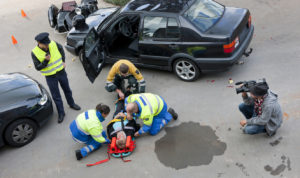
When you hire WGK Personal Injury Lawyers, here is what we actually do on your case. We open an investigation while the evidence still exists:
- We gather hospital, EMS, and treating physician records that demonstrate the severity of the injury.
- We bring in the right experts, including medical specialists, life-care planners, vocational economists, and accident reconstructionists, to establish causation and to prove damages.
- We identify every defendant and every insurance layer, build the demand around your full lifetime cost of care, negotiate with the carrier, and file suit and take the case to trial when the offer does not reflect what you have lost.
We treat each catastrophic case as the lifetime financial event it is for the family.
WGK Personal Injury Lawyers has handled personal injury claims in Baltimore since 1977, with nearly 50 years in practice and nearly 100 years of combined attorney experience. WGK Personal Injury Lawyers has recovered over $100 million for our clients.
The case results described on this website are specific to the facts and legal circumstances of each individual matter and should not be taken as a representation, promise, or guarantee that you will achieve a similar result. Prior results do not guarantee or predict a similar outcome in any future case. Every case is different and must be evaluated on its own merits. The amounts shown reflect gross recoveries before the deduction of attorneys’ fees, costs, and expenses. This website is attorney advertising.
When you hire our Baltimore personal injury lawyers, you will receive the benefit of:
- The right resources: Whenever it helps your case, we consult our network of leading Maryland experts, including medical specialists, life-care planners, vocational economists, and accident reconstructionists, to determine causation or establish damages.
- Aggressive advocacy: Insurance companies routinely try to blame victims for their own injuries, because in Maryland an accident victim found even 1% at fault can be barred from recovery under the state’s pure contributory negligence rule. We defend against every attempt to devalue your claim or settle it for less than it is worth.
After a serious crash, the adjuster’s job is to limit the insurer’s payment to the injured party. That usually means they will try to get a recorded statement that can be used against you, and make a quick, low offer before anyone knows what lifetime care will cost. When you hire us, you are trusting us to be your voice with insurance companies, corporations, and aggressive adversaries.
During nearly 50 years of experience in Baltimore, we have established working relationships with other attorneys, insurers, local courts, and judges. We can begin the work your case needs immediately, instead of spending time learning how to handle it. The arguments we make and the results we achieve directly affect your future and quality of life, so call us to learn more in a free consultation today.
What Are Common Types of Catastrophic Injuries in Baltimore?
When we refer to catastrophic injuries, we mean the most severe and life-changing injuries, often to the spine, spinal cord, brain, or injuries that cause multiple broken bones or limb amputations. These injuries usually mean lengthy recoveries, permanent disability, or wrongful death.
At WGK Personal Injury Lawyers, we represent people with catastrophic injuries involving:
Traumatic Brain Injuries
One of the most devastating injuries someone can endure is a blunt force to the head. The brain injuries we see most often come from traffic crashes, falls, and other high-impact accidents, and the damage often outlasts every other injury from the same event.
The Centers for Disease Control and Prevention has recorded approximately 214,110 traumatic-brain-injury-related hospitalizations in the United States in a single recent year, more than 586 per day.3 The CDC has also recorded 68,663 TBI-related deaths in a single recent year, an average of nearly 190 per day.4
Falls and firearm-related injuries are the leading cause of most moderate and severe TBI cases. Falls are a leading cause of TBI-related hospitalizations, especially among adults age 75 and older, and firearm-related suicide is linked to many TBI-related deaths. Motor vehicle crashes and assaults are other common ways a person sustains a moderate or severe TBI.5 The economic costs run at roughly $76.5 billion in lifetime costs in 2010 dollars, with hospitalized and fatal TBIs accounting for about 90% of total medical costs.6
Amputation Injuries
Losing a limb is a life-changing injury. An amputation may be traumatic, where the limb is severed in the crash itself, or surgical, when the damage from a severe accident leaves no way to save the limb. Along with permanent disfigurement, amputees face a lifetime of managing their injury, prosthetic costs, and lost earning capacity.
A 2024 study by Avalere Health for the Amputee Coalition, examining how many people live with amputation, found that approximately 5.6 million Americans are living with limb loss or limb difference: roughly 2.3 million with limb loss and 3.4 million with limb difference.7 The study estimated that trauma cases account for roughly 45% of acquired limb loss, with motor vehicle crashes, workplace incidents, and other traumatic mechanisms accounting for the bulk of that share.
Spinal Cord Injuries
Motor vehicle accidents are the leading cause of spinal cord injuries. This traumatic injury often causes permanent changes in strength and feeling below the site of the injury. Loss of movement, altered sensation, loss of bowel and bladder control, and difficulty breathing can all contribute to devastating permanent disability.
The National Spinal Cord Injury Statistical Center estimates that approximately 18,000 new traumatic spinal cord injuries occur each year in the United States, an incidence rate of about 54 cases per million people.8
Lifetime direct medical costs vary sharply, depending on the severity of the injury. For a 25-year-old, NSCISC data in 2014 dollars put the figures at:9
- High tetraplegia (C1-C4): about $4.7 million
- Lower tetraplegia (C5-C8): about $3.5 million
- Paraplegia: about $2.3 million
- Motor-incomplete: about $1.6 million
Current-dollar figures are substantially higher, and none of those numbers include lost wages and productivity over the injured person’s working life.
Broken Bones
Some fractures are relatively minor, but when a person suffers multiple broken bones or crushed and shattered bones, surgical intervention and stabilization may be required. Recovery can take months without the ability to bear any weight, and some breaks never heal correctly.
Severe Burn Injuries
Burn cases tend to result from apartment and house fires, vehicle fires after crashes, gas explosions, scalding incidents, and industrial or electrical accidents. They rank among the most demanding catastrophic claims we handle because treatment and reconstruction can stretch over years.
Burn injuries are among the most painful injuries a person can endure, and many people report that the wound care and recovery hurt more than the original trauma. Without treatment, burns are subject to dangerous infections and life-threatening complications.
The Healthcare Cost and Utilization Project’s National Inpatient Sample, published by the American Burn Association, reports approximately 29,165 burn injuries require hospital admission each year in the United States, a rate of about 88.5 admissions per million people, with an in-hospital mortality rate of 2.7% in that national sample.10 The most recent group of burn-center patients showed an overall survival rate of 97.6%.10
When to Call a Catastrophic Injury Lawyer
A few clinical signs and types of care a person needs can tell a family that the injury they are dealing with is in the catastrophic class, not the routine personal-injury class. Any of the following should prompt a call to a lawyer within days, not weeks:
- Admission to the R Adams Cowley Shock Trauma Center on the University of Maryland Medical Center campus11
- Transport from the scene by Maryland State Police medevac helicopter or air-EMS
- An ICU stay of more than 24 to 48 hours
- A ventilator, feeding tube, or external fixator placed during inpatient care
- A doctor or social worker recommending a life-care planner
- A permanent disability rating from a treating physician or independent medical examiner
- Multi-system polytrauma, where more than one major body system is injured
- A diagnosis of spinal cord injury, severe TBI, traumatic amputation, or third-degree burns
Getting counsel early matters in a catastrophic case for practical, not theoretical, reasons.
Evidence preservation has to begin within days. Multiple insurance layers, including the at-fault driver, employer, vehicle owner, and your own coverage, must be identified before you accept any settlement money. Government-defendant claims carry a much shorter notice deadline than the general statute of limitations. Calling early does not mean filing suit early; it means starting the documentation and preservation work while the family focuses on hospital care.
Maryland Treatment Pathways and the R Adams Cowley Shock Trauma Center
Treatment at the R Adams Cowley Shock Trauma Center, on the University of Maryland Medical Center campus in downtown Baltimore, is itself a marker of catastrophic injury. Shock Trauma is Maryland’s designated trauma hospital for the most severely injured and critically ill patients. Over its 50-year history, more than 200,000 patients have been cared for at the center, with approximately 95% surviving their injuries.11
Routine ER visits in the Baltimore area typically go to Sinai Hospital, MedStar Harbor, MedStar Good Samaritan, GBMC, Mercy Medical Center, Johns Hopkins Bayview, or Patient First. Catastrophic injuries route to Shock Trauma.
This matters for your case, not just your care. Severely injured patients are transported to Shock Trauma by Maryland State Police medevac helicopters and through the statewide EMS system. If your loved one was flown there or admitted from the field, the medical record alone tells the jury and the adjuster something about the severity of what happened, and that record becomes a foundation of the damages claim.
Shock Trauma’s caseload reflects Maryland’s broader burden of serious crashes, which has risen in recent years. Maryland’s statewide crash summary has recently recorded roughly 577 fatal crashes in a single year, above the five-year average of around 535.12
Maryland’s most recent Highway Safety Improvement Program data identified roughly 3,010 serious-injury crashes (suspected serious injury, broken bones, severe lacerations, head injuries, internal injuries, and unconsciousness) on Maryland roadways in a recent reporting year.13 These figures are the closest Maryland-specific indication of the catastrophic-injury caseload that feeds Shock Trauma and ends up in offices like ours.
Common Causes of Catastrophic Injuries
A catastrophic injury can result from any severe accident. Our catastrophic injury lawyers have represented victims of severe crashes, animal attacks, and violent assaults. The cases we see most often fall into a handful of cause categories, each with its own mechanism for producing catastrophic harm rather than a routine injury.
Motor vehicle crashes drive the largest share of catastrophic cases. Car accidents, truck accidents, motorcycle accidents, bicycle accidents, pedestrian accidents, and boating accidents all produce catastrophic outcomes through the same basic mechanism: large mass and high speed against a vulnerable body. A pedestrian or motorcyclist struck by an SUV is far more likely to end up at Shock Trauma than the SUV driver.
Workplace and construction events cause catastrophic injuries from falls, crushing mechanisms, and heavy equipment. A construction accident involving a scaffolding collapse or a fall from a roof can cause spinal cord injuries, traumatic brain injuries, or multiple fractures in a single event.
Premises and building failures account for a smaller share of cases in number, but are disproportionately catastrophic in outcome. A slip and fall accident on a hard surface can produce a TBI in an older adult. Building collapses and severe dog bites, particularly to children, can cause permanent disfigurement and disability.
Defective products, fires, and explosions create catastrophic injuries through high-energy releases. Burns, amputation, and inhalation injuries from these events tend to require months of acute care and years of reconstructive treatment. The most severe cases proceed as wrongful death actions when the victim does not survive.
What Damages Are Available in a Baltimore, MD Catastrophic Injury Claim?
One of the most common questions in a personal injury claim is "how much is my claim worth?" Because catastrophic injuries have long-lasting and far-reaching effects on the injured person’s life, the damages are often significant. If we represent you, we will pursue every available avenue of compensation from every liable party.
We will fight to recover damages for:
- Ambulance transport
- Hospitalization
- Medical follow-up visits
- Surgeries
- Rehabilitation
- Nursing care
- Pharmaceutical medications
- Medical devices and home modifications
- Chronic pain
- Loss of enjoyment of life
- Emotional distress
- Temporary or permanent disability
- Lost wages
- Lost earning capacity
Maryland recognizes two main categories of damages in personal injury cases: economic damages and non-economic damages. Economic damages have no statutory limit and can include the lifetime cost of medical care, attendant care, home and vehicle modifications, durable medical equipment, and lost earning capacity.
In catastrophic cases, we typically work with a certified life care planner to project these costs over the injured person’s lifetime. That’s because the dollar figure today does not capture what care will cost over the next 30 or 40 years.
Non-economic damages cover the person’s pain itself and the limitations the injury imposes on their daily life: activities the client can no longer do, routine tasks that have become difficult, and the reduced enjoyment of life. Maryland also recognizes pre-impact fright as a non-economic damages category: the awareness that an unavoidable collision is imminent, with no opportunity to prevent it. Pre-impact fright comes up most often in catastrophic-injury and wrongful-death cases where the victim had time to perceive the impending impact.
Maryland’s non-economic damages cap applies to every personal injury case, including catastrophic injuries, auto accidents, premises liability, and wrongful death. The cap, codified at Md. Code, Cts. & Jud. Proc. § 11-108 sets a base limit and increases it by $15,000 each October 1.14 The cap that governs is the one in effect on the date of the accident, not the date the lawsuit is filed.
Punitive damages in Maryland require a showing of "actual malice," meaning an intent to injure or evil motive. This is an extremely high standard that is nearly impossible to meet in a typical catastrophic injury case involving a motor vehicle, premises, or workplace. Maryland courts reserve punitive damages for cases involving intentional misconduct, not ordinary or even gross negligence. Most catastrophic-injury cases do not produce punitive damages.
Do not accept any compensation for a personal injury claim without first speaking to a knowledgeable personal injury lawyer. At WGK Personal Injury Lawyers, we can review your accident, injuries, and potential case to determine how much your case may be worth.
Who’s Liable For My Catastrophic Injuries After an Accident in Baltimore?
Liability in a catastrophic injury case depends on how the injury happened. In a motor vehicle crash, the at-fault driver is the primary defendant. In some cases, the driver’s employer, the vehicle owner, the company that maintained the vehicle, or a commercial entity using the driver’s services can be on the hook as well. In a truck accident, the trucking company, the trailer owner, and the company that loaded or maintained the equipment can each be separately liable, often with separate insurance layers on each piece of equipment.
In a premises catastrophic injury, the property owner, the management company, and any contractor performing work at the location may share liability. In a defective-product case, the manufacturer, distributor, and seller in the distribution chain can be joined as defendants. In a construction accident, general contractors, subcontractors, equipment owners, and adjacent property owners can all be held liable.
Building the liability case in a catastrophic matter takes more than naming the obvious defendant. The reason is simple: in a catastrophic case, a $30,000 or $100,000 policy on the obvious defendant covers a small fraction of the medical bills alone. What you can actually recover for your care depends on finding every defendant and every policy.
Maryland Law: The Non-Economic Cap, Contributory Negligence, and Where You File
Maryland follows a pure contributory negligence rule: a plaintiff who is even 1% at fault for an accident is generally barred from any recovery. Nearby D.C. and Virginia apply the same standard.
In catastrophic-injury cases, insurance defense lawyers routinely argue that the injured party shares some fault, because a finding of even 1% fault eliminates a multi-million-dollar case entirely.
Under Maryland case law, being negligent is not enough by itself to be contributorily negligent.
The plaintiff’s negligence has to have actually contributed to causing the crash or the injuries. Speeding alone, or being slightly outside a crosswalk, does not automatically bar recovery; the defense must show that the plaintiff’s conduct was a cause of the crash.
Alongside contributory negligence, the non-economic damages cap discussed above is the single most important rule shaping the value of a catastrophic case. The cap that governs is the one in effect on the date of the accident, not the date the lawsuit is filed. A crash that happened before October 1, 2025 falls under the prior year’s cap, even if suit is filed in 2026 or 2027.
In Maryland, you can file a personal injury lawsuit either where the accident occurred or where the defendant lives. You do not get to pick whatever county you prefer. If both are in the same county, the case is filed there.
Most Baltimore-area catastrophic injury cases involving City of Baltimore residents are filed in the Circuit Court for Baltimore City. A catastrophic crash on one of the interstates surrounding the city may instead be filed in the county where it occurred (Baltimore County, Anne Arundel County, Howard County, or another county along the route), which carries meaningful consequences for jury composition and venue tendencies.
Insurance Coverage in Catastrophic Cases
Maryland requires minimum auto bodily injury liability coverage of $30,000 per person and $60,000 per accident, plus $15,000 for property damage.15 Uninsured and underinsured motorist coverage (UM/UIM) is required by Maryland law and defaults to the same limits as liability coverage unless the policyholder declines higher limits.
In a catastrophic injury case, the Maryland minimum is rarely enough to cover even the initial hospitalization. The first-year medical cost alone for a high tetraplegia spinal cord injury runs over a million dollars. A $30,000 policy covering the at-fault driver disappears in the first day or two of inpatient care. Catastrophic-injury recovery often requires identifying and stacking multiple insurance layers:
- The at-fault driver’s primary liability policy
- The at-fault driver’s employer’s commercial policy, if the crash happened in the scope of employment
- For trucks: separate policies on the tractor, the trailer, and the hardware attaching them
- The injured party’s underinsured motorist coverage (UIM)
- The injured party’s Enhanced Underinsured Motorist coverage (EUIM), if elected
- Any rideshare commercial coverage that applies based on the driver’s status at the time of the crash
- Premises and contractor policies on building-collapse, construction, and premises cases
- The Maryland Unsatisfied Claim and Judgment Fund, in limited circumstances
Before you can recover from your UIM or EUIM coverage in Maryland, the at-fault driver’s liability policy must first be exhausted. You cannot tap your own underinsured motorist coverage from the first dollar. Standard UIM also includes an offset, meaning your UIM credit shrinks by whatever the at-fault driver pays: if the defendant has a $30,000 policy and you carry $100,000 of UIM, your UIM pays the difference, up to a total of $100,000 from both policies combined.
Enhanced UIM operates the same as regular UIM except there is no offset against the defendant’s policy. EUIM stacks on top of the at-fault driver’s policy. If the defendant has $30,000 and you carry $100,000 of EUIM, your total recovery from the two policies combined is $130,000. EUIM has to be elected and paid for separately as additional coverage; Maryland insurers are required to offer EUIM, but it is not automatically attached to every policy. For catastrophic injuries, EUIM is often the single most valuable coverage decision a driver can make.
This is marketing material and is not legal advice. Every case is unique and laws change frequently. Please contact our office to speak with an attorney about your specific situation before making any legal decisions.
What’s the Statute of Limitations for Catastrophic Injury Cases in Maryland?
Maryland’s general personal injury statute of limitations is three years from the date the cause of action accrues, set by Md. Code, Courts and Judicial Proceedings § 5-101.16 The same three-year rule applies to catastrophic-injury cases as to any other personal injury action.
Cases against Maryland local government agencies and certain state-affiliated entities carry a much shorter notice deadline. Under the Local Government Tort Claims Act, the notice period is one year from the date of the injury. Missing the LGTCA notice deadline bars recovery entirely on government-defendant claims, even if the three-year statute has not run.17 Catastrophic injuries involving public-vehicle crashes, road-design defects, or public-property premises are common cases where the LGTCA window catches families off guard while they are focused on hospital care.
Federal-vehicle catastrophic cases (United States Postal Service, Department of Veterans Affairs, federal agency vehicles) involve a different framework under the Federal Tort Claims Act.
The earlier you call an attorney after a catastrophic injury, the better. Evidence preservation has to start within days. Surveillance footage from nearby businesses can be overwritten within days to weeks on rolling retention cycles, dash-cam footage gets erased, and witnesses become harder to reach. Hospital and EMS records take weeks to compile. We never want a family to learn about the LGTCA notice deadline four months after the crash because no one told them.
Frequently Asked Questions
What is considered a catastrophic injury under Maryland law?
Maryland does not have its own statutory definition. In practice, a catastrophic injury is one that permanently changes the way a person can live, work, or care for themselves. The most common categories are traumatic brain injuries, spinal cord injuries causing paralysis, severe burns, traumatic amputations, multi-system polytrauma, and severe organ damage. The R Adams Cowley Shock Trauma Center is Maryland’s designated trauma hospital for the most severely injured and critically ill patients.11
Does Maryland’s damages cap apply to my catastrophic injury case?
Yes. Maryland’s non-economic damages cap applies to every personal injury case, including catastrophic injuries. The full mechanics, the current dollar figure, and the accident-date-binding rule are explained in the damages section above. What it means for a catastrophic case: if the case has a life-care plan of $5,000,000, economic damages can recover the full amount, but non-economic damages are limited regardless of how badly the client was hurt. That is one reason we build the economic side of the case so carefully.
What if the at-fault driver’s insurance policy is too small to cover my catastrophic injuries?
This is the rule, not the exception, in catastrophic cases. Maryland’s minimum auto policy of $30,000 per person is exhausted within the first day or two of inpatient hospitalization. Catastrophic recovery typically requires stacking the at-fault driver’s policy with your own uninsured or underinsured motorist coverage, commercial coverage on trucks and rideshare vehicles, premises and contractor policies, and Enhanced UIM if you carry it. Finding and stacking those layers is a core part of what we do.
Can I recover future medical and life-care costs in a Maryland catastrophic injury case?
Yes. Maryland law allows recovery of future medical expenses and lost earning capacity as economic damages, which are not capped by statute. In a catastrophic case, we work with a certified life care planner to project costs over your lifetime, including surgeries, therapy, attendant care, durable medical equipment, home and vehicle modifications, and medication.
Are punitive damages available in a Maryland catastrophic injury case?
Almost never. The actual-malice standard, and the reason ordinary or gross negligence does not qualify, is explained in the damages section above. The narrow set of catastrophic cases where punitives are realistically pleadable involves intentional or near-intentional misconduct: a defendant who falsified safety records that concealed a known hazard, or a property owner who knew about a dangerous condition and actively hid it. Even those cases face Maryland’s clear-and-convincing-proof standard, so most catastrophic recoveries are built on the economic-damages-and-capped-non-economic-damages framework.
What does it cost to hire WGK Personal Injury Lawyers for a catastrophic injury case?
Nothing upfront. WGK Personal Injury Lawyers handles catastrophic-injury cases on contingency: 33.3% of the gross recovery before suit is filed, and 40% after suit is filed (regardless of whether the case proceeds to trial). When there is a recovery, the case costs we advanced are reimbursed to us out of the gross settlement. If there is no recovery, you owe no fee and no costs.
How long do catastrophic injury cases take to resolve?
Longer than routine cases, almost always. Treatment usually has to be substantially complete, or stabilized at maximum medical improvement, before a fair demand can be made, because the medical record drives the economic damages projection. Catastrophic cases involve life-care planning, vocational economics, and multiple layers of insurance, all of which take time to develop. Pushing for a fast settlement before the full cost of care is known usually means leaving money the family will need on the table.
How does Maryland’s contributory negligence rule affect a catastrophic injury case?
It can be decisive. In a catastrophic case, the practical impact is that defense lawyers commit significant resources to building a partial-fault theory, because even a 1% finding eliminates a multi-million-dollar claim.
What is the Local Government Tort Claims Act notice deadline and when does it apply to a catastrophic injury case?
The LGTCA notice rule, the one-year written-notice window, and the bar to recovery for a missed deadline are explained in the statute of limitations section above. In a catastrophic case, the practical risk is timing: families consumed with Shock Trauma admissions, ICU stays, and rehab placement often miss the notice window without realizing a government defendant is in the case. The notice itself must be in writing and served on the appropriate local government agency (typically the county or city solicitor’s office) rather than on the agency that owned the vehicle or controlled the road. That’s why getting to an experienced catastrophic injury attorney early is so important.
What is Enhanced Underinsured Motorist (EUIM) coverage and why does it matter in a catastrophic injury case?
EUIM is a Maryland auto coverage that stacks rather than offsets, and the mechanics (the $30,000 + $100,000 \= $130,000 example and the separate-election requirement) are explained in the insurance coverage section above. In a catastrophic case, EUIM is often the single coverage line that determines whether a family can fund lifetime care. We routinely see catastrophically injured clients whose recovery either ends at the at-fault driver’s $30,000 minimum policy or extends meaningfully into their own EUIM layer, depending on whether that coverage was elected before the crash.
Get a Free Consultation with a Baltimore Catastrophic Injury Lawyer
If you or a loved one has been catastrophically injured in an accident in the Baltimore area, time matters. The insurance company will move quickly to limit your recovery, and evidence becomes harder to obtain with every passing day.
At WGK Personal Injury Lawyers, your first consultation is free and confidential. We work on a contingency fee basis: 33.3% of the gross recovery before suit is filed, and 40% if a lawsuit is filed. When there is a recovery, the case costs we advanced are reimbursed to us out of the gross settlement. If there is no recovery, you owe no fee and no costs.
After a catastrophic injury, daily life fills up fast with medical appointments, physical therapy, time off work, and insurance calls. We do not add to that load. Most of a personal injury case can be handled by phone, documents can be signed remotely, and your settlement payment is mailed directly to you when the case resolves. In-person meetings at our Baltimore office at 14 W. Madison Street are welcome but never required.
You will generally have just three years to file a lawsuit, and shorter notice periods may apply for government-defendant cases. Contact our Baltimore law office today to arrange a free initial case evaluation. Our team is available to take your call at (410) 837-2144.
Find out more about our office location. We serve all neighborhoods throughout the Baltimore region, including:
- Sharp Leadenhall
- Westside
- Hampden
- Dundalk
- Locust Point
- Charles Village
- Downtown
- Fell’s Point
- Federal Hill
Baltimore Catastrophic Injury Client Review
Read more of our Google reviews.

Sources
- Cornell Legal Information Institute, U.S. Code Title 34 § 10284 (2024). Federal statutory definition of “catastrophic injury” under the Public Safety Officers’ Benefits Act. https://www.law.cornell.edu/uscode/text/34/10284
- Justia Legal Encyclopedia, Catastrophic Injuries & Related Legal Claims (2024). General legal-concept framing of the three defining characteristics of catastrophic injuries. https://www.justia.com/injury/types-of-injuries/catastrophic-injury/
- Centers for Disease Control and Prevention, TBI Data and Research (2020). National TBI-related hospitalization figure of approximately 214,110 in 2020. https://www.cdc.gov/traumatic-brain-injury/data-research/index.html
- Centers for Disease Control and Prevention, TBI Data and Research (2023). National TBI-related death figure of 68,663 in 2023, nearly 190 per day. https://www.cdc.gov/traumatic-brain-injury/data-research/index.html
- Centers for Disease Control and Prevention, About Moderate and Severe TBI (2024). Leading causes of moderate and severe TBI: falls, motor vehicle crashes, assaults, firearm-related suicide. https://www.cdc.gov/traumatic-brain-injury/about/moderate-severe-tbi.html
- Centers for Disease Control and Prevention, About Moderate and Severe TBI (2010 dollars). Lifetime economic cost of TBI estimated at approximately $76.5 billion. https://www.cdc.gov/traumatic-brain-injury/about/moderate-severe-tbi.html
- Amputee Coalition / Avalere Health Limb Loss Prevalence Study (2024). Prevalence of limb loss and limb difference in the United States. https://amputee-coalition.org/5-6-million-americans-living-with-limb-loss-limb-difference/
- National Spinal Cord Injury Statistical Center, FAQ (2023). Annual incidence of 18,000 new SCI cases, prevalence range of 257,000 to 388,000. https://sites.uab.edu/nscisc/faq/
- Christopher and Dana Reeve Foundation, Costs of Living with Spinal Cord Injury (citing NSCISC, 2014 dollars). Lifetime medical cost figures for SCI by severity at age 25. https://www.christopherreeve.org/todays-care/living-with-paralysis/costs-and-insurance/costs-of-living-with-spinal-cord-injury/
- American Burn Association, Burn Incidence Fact Sheet (2024). Annual burn admissions (29,165), incidence rate, mortality, and burn-center survival data. https://ameriburn.org/resources/burn-incidence-fact-sheet/
- University of Maryland Medical System Foundation, R Adams Cowley Shock Trauma Center (2024). Statewide trauma-system role, 200,000-patient cumulative history, 95% survival rate. https://secure.ummsfoundation.org/site/PageServer?pagename=STC_About
- Zero Deaths Maryland (MDOT MVA Highway Safety Office, 2023). Maryland statewide traffic fatality and injury totals. https://zerodeathsmd.gov/resources/crashdata/
- Maryland Highway Safety Improvement Program Annual Report (FHWA, 2024). Maryland serious-injury crash data for 2023 (approximately 3,010 serious-injury crashes). https://highways.dot.gov/sites/fhwa.dot.gov/files/2025-03/HSIP_Report_MARYLAND_2024_508.pdf
- Maryland General Assembly, Md. Code, Cts. & Jud. Proc. § 11-108 (2025). Non-economic damages cap statute. https://mgaleg.maryland.gov/mgawebsite/laws/StatuteText?article=gcj§ion=11-108
- MDOT Motor Vehicle Administration, Auto Insurance Requirements in Maryland (2024). Maryland minimum auto liability coverage of $30,000 per person and $60,000 per accident, plus $15,000 property damage. https://mva.maryland.gov/vehicles/Pages/insurance-requirements.aspx
- Maryland General Assembly, Md. Code, Cts. & Jud. Proc. § 5-101 (2024). General statute of limitations for civil actions: three years from accrual. https://mgaleg.maryland.gov/mgawebsite/laws/StatuteText?article=gcj§ion=5-101
- Maryland Local Government Tort Claims Act, Md. Code, Cts. & Jud. Proc. §§ 5-301 through 5-304 (2024). Notice requirements for claims against Maryland local governments.