





You’re hurt, the bills are already showing up, and the driver’s insurance company wants a recorded statement. That’s a lot to deal with while you’re still in pain.
If someone else caused your electric scooter crash in Baltimore, you may be owed money for your medical care, your lost wages, and your pain. A Baltimore electric scooter accident lawyer at WGK Personal Injury Lawyers will review what happened for free. Call (410) 837-2144 to talk with our legal team about your options.
Electric scooters are a cheap, quick way to move around the city. They’re also easy for a driver to miss. When a driver doesn’t see you, you absorb the full impact of the crash, and they don’t.
WGK has represented injured Marylanders for nearly 50 years. Our attorneys bring nearly 100 years of combined attorney experience to a case. We’ve recovered over $100 million for our clients.
The case results described on this website are specific to the facts and legal circumstances of each individual matter and should not be taken as a representation, promise, or guarantee that you will achieve a similar result. Prior results do not guarantee or predict a similar outcome in any future case. Every case is different and must be evaluated on its own merits. The amounts shown reflect gross recoveries before the deduction of attorneys’ fees, costs, and expenses. This website is attorney advertising.
Table of Contents
How WGK Helps After a Baltimore Scooter Accident
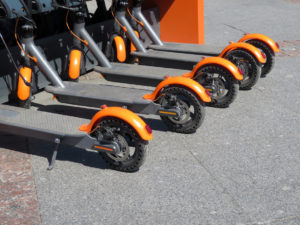
Scooter riders get treated as an afterthought by insurance companies. Riders are newer to Baltimore streets than cars or bikes. Most riders don’t know the rules that apply to them, and adjusters use that gap. Here’s what we actually do about it.
- Investigate the crash. We get the police report, find witnesses, photograph the scene, and identify every party who may owe you money.
- Preserve the evidence before it disappears. We send preservation letters to the driver, the scooter operator, and any nearby business with camera footage.
- Pull the scooter’s trip data. Brake and throttle logs, maintenance flags, and the unit’s ride history can prove a mechanical failure.
- Gather your records. Medical bills, treatment notes, imaging, and wage records build the number we demand.
- Build and send the demand. We assign a documented value to your claim rather than letting the adjuster pick one.
- Negotiate hard, then file suit. If the offer doesn’t reflect what you lost, we file the case and take it to trial.
You don’t pay us anything up front. There’s no cost to find out where you stand, whether you just got out of the ER or you already have an offer sitting in your inbox.
Injured, Hon? We can help.
Free consultation. You pay nothing unless we win.
How Often Do Electric Scooter Crashes Happen?
Scooter injuries are climbing fast nationally. Federal injury-surveillance data recorded a sharp rise in e-scooter emergency-room injuries over a recent 5-year span, from roughly 8,566 to 56,847 a year, along with an estimated 111 e-scooter-related deaths.1
The trend hasn’t slowed. More recent federal surveillance data show scooter emergency-room injuries topped 118,000 in a single year. That’s an 80% jump from the year before and nearly triple the level of a few years earlier. More than 18% of those injuries involved the head.2
Baltimore reflects that risk. In a recent reporting year, the city saw dozens of traffic deaths and hundreds of serious injuries across thousands of crashes. Non-motorists, including people walking, biking, and riding scooters, made up more than half of those deaths.3
That head-injury share matters for your claim. A concussion or brain injury drives both the medical bills and the long-term damages, and it’s also the injury an insurer fights hardest to minimize.
Baltimore’s Scooter Rules and Why They Come Up in Your Case
The Baltimore City Department of Transportation sets rules for shared scooters. Riders must4:
- Wear a helmet if under age 16
- Use bike lanes where they exist
- Ride on the right side of the road where there’s no bike facility
- Stay off sidewalks unless the posted speed limit is 30 mph or greater
- Avoid blocking bus stops, bike racks, driveways, and car doors when parking
Drivers have obligations too. A driver must give a scooter at least 3 feet of space when passing.4 That 3-foot rule is reinforced by the Sarah Debbink Langenkamp Memorial Act, covered in the Maryland law section below.
Expect the insurance company to comb these rules for something you did wrong. Where you rode and whether you wore a helmet will come up. Neither one automatically ends your claim.
Common Causes of Electric Scooter Accidents in Baltimore
Most scooter crashes we see trace back to one of these:
- A driver failing to yield the right of way
- Unsafe or sudden turns across a rider’s path
- Distracted driving
- Driving under the influence of drugs or alcohol
- Defective scooter components or brake failure
- A scooter that wasn’t kept in safe condition
- Road hazards and pavement defects
- Rider inexperience
- Riding where scooters aren’t allowed
- Missing lights or other safety equipment
Each cause points at a different party who may owe you compensation. That’s why the cause matters as much as the injury.
Scooter Crashes Cause Serious Injuries
You might walk away from a scooter crash with scrapes. Many riders don’t. Like a motorcycle or a bike, a scooter gives you nothing between your body and the road.
Clinical research indicates scooter injuries more often require surgery than comparable bicycle injuries, and federal data attributes most scooter injuries to falls.5 A crash that looks minor can still leave you with a fractured wrist, a concussion, or worse.
Common scooter injuries include:
- Head injuries and concussions
- Traumatic brain injuries
- Broken bones
- Spinal cord injuries and paralysis
- Road rash
- Neck and back injuries
- Knee, hip, and shoulder injuries
- Internal organ damage
At worst, a scooter crash can be fatal. A wrongful death claim is then the family’s only route to recover medical bills, funeral costs, and the income they’ve lost.
Either way, the size of the recovery reflects how well the injuries are documented and how quickly the responsible parties are identified. That’s why calling early so often changes the outcome.
Who Can Be Held Responsible for Your Scooter Crash
First, we find out what actually happened. A car ran a red light. The brakes gave out.
A pothole threw you off. The answer decides who owes you money.
Depending on the cause, that can include:
- The at-fault driver in a motor vehicle crash
- The scooter-share operator, such as Lime or Spin
- The manufacturer of a defective scooter or component
- A government entity responsible for a dangerous or defective roadway
- A property owner who let a sidewalk or lot become unsafe
More than one party can share the blame for a single crash. If a documented brake failure, throttle malfunction, or other defect contributed, the scooter operator or the manufacturer may be on the hook alongside the driver.
When a government agency is involved, through a city vehicle or a government-maintained road defect, much shorter deadlines apply under the Local Government Tort Claims Act. Those deadlines are covered in the deadlines section below.
Evidence That Proves Fault in a Scooter Crash
Scooter cases turn on evidence that disappears quickly. A scooter goes back into the fleet, gets recharged, gets ridden again, and the record of your trip goes with it.
Here’s what we move to lock down:
- Scooter telemetry. Speed, braking, and throttle data from your ride, plus the unit’s maintenance flags and any prior crashes on the same scooter.
- Video. Traffic cameras, nearby business cameras, and doorbell cameras usually overwrite on a short loop.
- The police report and 911 records. These fix the time, location, and the driver’s initial account before the story changes.
- Witnesses. Other riders, drivers, pedestrians, and nearby employees who saw the impact.
- Medical records. Emergency treatment, imaging, and follow-up care connect the injury to the crash.
- Roadway records. Prior complaints, repair logs, and inspection records matter when a defect in the street caused the fall.
We send preservation letters to every party who might hold that evidence. A letter that goes out in the first week does what no amount of arguing can do six months later.
Maryland Law for Electric Scooter Riders
Maryland treats a shared scooter as a defined vehicle class, not an unregulated toy. Under Md. Code, Transportation Sec 11-117.2, an electric low-speed scooter6:
- Carries only the operator
- Weighs less than 100 pounds
- Has handlebars and a standing platform
- Runs on an electric motor plus human power
- Reaches a top speed of 20 mph
Maryland also sets equipment rules, including front and rear lighting for night riding and a working brake (Md. Code, Transportation Sec 21-1207).7
Maryland Uses Pure Contributory Negligence
Maryland follows pure contributory negligence. If you’re even 1% at fault for causing the crash, you can be barred from recovering anything. Maryland provides no vulnerable-road-user exception for scooter riders.
A Technical Violation Doesn’t Automatically End Your Case
Being negligent isn’t the same as being contributorily negligent under Maryland case law. Your negligence has to have actually contributed to causing the crash or the injuries.
So a technical violation, such as riding where scooters aren’t allowed, skipping a helmet, or crossing against a signal, is only evidence of negligence. It doesn’t bar your recovery if it didn’t contribute to causing the crash or the injuries. Maryland’s appellate courts have reversed dismissals on exactly this point.
That distinction is why we take scooter cases some firms turn away. The insurer’s first move is usually to point at something the rider did. The question that decides the case is whether it contributed to causing the crash or the injuries.
Deadlines: The 3-Year Clock and the Government Exception
Maryland’s general personal injury statute of limitations is 3 years from the date of the crash (Md. Code, Cts. & Jud. Proc. Sec 5-101).8
The exception is the one that catches people. If a city or county vehicle, or a government-maintained roadway defect, was involved, a much shorter notice deadline applies under the Local Government Tort Claims Act. That’s generally 1 year after the injury for a local government, and 1 year for the State of Maryland.
Waiting on the 3-year clock with a government defendant can end your claim before you file. Maryland’s discovery rule won’t extend the 3-year clock for a routine scooter, auto, or pedestrian case either. The clock runs from the date of the accident.
The Bike-Lane Strike Law
Under the Sarah Debbink Langenkamp Memorial Act (Maryland HB 337), a driver who strikes someone riding a bicycle, motor scooter, or electric personal assistive device in a bike lane or on a shoulder and causes serious injury or death can face up to $2,000 in fines and up to 2 months in jail.9
That’s a criminal penalty against the driver, not your compensation. Your civil claim for medical bills, lost wages, and pain and suffering runs separately under standard Maryland personal injury rules. The criminal charge can still help you, because it documents what the driver did.
How Much Is Your Baltimore Scooter Accident Claim Worth?
Fair compensation matters most when you can’t work for months, and the medical care keeps stacking up. That’s also the number the insurance company is trained to compress.
When a carrier knows it’s exposed, it often puts an offer on the table fast, hoping you take it before anyone tells you what the claim is actually worth. Talk to a lawyer before you sign anything.
What Affects the Value of Your Claim
- Medical bills you’ve already incurred, plus the care you’ll still need
- Length of treatment and recovery, including physical therapy and rehabilitation
- Lost wages and lost earning capacity if you can’t do the job you had
- Permanent injury or disability, which carries value for the rest of your life
- Your age and life expectancy, since a permanent limitation costs a 28-year-old more years than it costs a retiree
- Pain and suffering, which in Maryland covers the physical pain plus the daily activities and routine tasks the injury took from you
- Whether you followed your treatment plan, because a defense lawyer will argue that gaps in care made the injury worse
Maryland’s Cap on Non-Economic Damages
Maryland caps non-economic damages in every personal injury case, and scooter cases are no exception. For causes of action arising on or after October 1, 2025, the cap is $965,000 per injured person. It rises to $1,447,500 in wrongful death cases with two or more beneficiaries. The cap rises by $15,000 each year on October 1.10
The cap that governs is set by the date of the accident, not the date the lawsuit gets filed. It applies to auto and premises claims too, not just medical malpractice.
Economic damages have no statutory limit, so your medical bills and lost wages aren’t capped. Damage to your own scooter or personal property is a separate property claim, and it doesn’t reduce your bodily-injury recovery.
How Insurance Works After a Scooter Crash
A scooter rider hurt by a motor vehicle in Maryland recovers first from the at-fault driver’s bodily injury liability coverage. Maryland’s minimum required policy is $30,000 per person and $60,000 per accident.
Maryland personal injury protection (PIP) is a no-fault benefit, typically up to $2,500 for medical bills and lost wages, paid regardless of fault. PIP comes on Maryland auto policies unless it’s waived in writing. A scooter rider can only use PIP through a household auto policy, so it’s available if you or someone in your household has one.
The insurer can’t take PIP and Med-pay benefits back out of your settlement. You keep them on top of any liability recovery.
If the Driver Was Uninsured and You Don’t Own a Car
Plenty of shared-scooter riders don’t own a vehicle. If the at-fault driver has no insurance and you have no household auto policy, Maryland’s Unsatisfied Claim and Judgment Fund can provide up to $30,000 per person for non-motorists, including scooter riders.
The fund doesn’t cover the uninsured driver. For a rider without a car, it’s often the only first-party safety net, and it has its own much shorter filing requirements. That’s one more reason to get a lawyer involved early.
What the Adjuster Will Do
Coverage is half the equation. How the carrier behaves once your claim opens is the other half, and carriers aren’t all the same.
Some insurers deny liability even in clear-fault crashes and reduce the billed medical charges, which can force a lawsuit to obtain fair value. Others make an early, low offer before your treatment is finished, when nobody knows yet what the injury will cost.
Two rules protect you from both. Don’t give a recorded statement before you talk to an attorney, and don’t accept an early offer while you’re still treating.
What to Expect When We Handle Your Case
The strongest results come from cases built early, with prompt treatment and preserved evidence. That’s true across scooter, bicycle, pedestrian, motorcycle, and rideshare claims.
Treatment timing is the part riders control. According to attorney Mary Finke, insurers start discounting the case value when initial treatment is delayed by 3 to 5 days, and a gap of 10 to 14 days can put the claim at risk. Getting treated and documented is one of the strongest steps you can take for your recovery and your case.
Timing also shapes how long the case takes. According to attorney Hunter Duke, a soft-tissue claim runs roughly 4 to 7 months from intake to a pre-suit settlement.
This commentary reflects experience in past matters. It is marketing material, not legal advice, and past results do not guarantee future outcomes.
We keep you updated by phone, email, or text throughout. You’ll know what’s happening with your claim without having to chase us.
Call a Baltimore Electric Scooter Accident Lawyer Today
If a driver, a defective scooter, or a broken street left you injured in Baltimore, we’ll tell you what your claim is worth and what it will take to get it. Our team works to hold the at-fault party accountable so you can pay for your care and get back to your life.
The consultation is free, and you pay nothing unless we recover compensation for you. Call (410) 837-2144 or contact our Baltimore office online for your free scooter accident case review.
Frequently Asked Questions
Can I recover if I was partly at fault for my Baltimore scooter accident?
Possibly. Maryland uses pure contributory negligence, so being even 1% at fault for causing the crash can bar your recovery. The key limitation is that your negligence must have actually contributed to causing the crash or the injuries.
Insurers reach for this defense reflexively in scooter cases, usually pointing at sidewalk riding, a missing helmet, or a signal you ran. A technical violation that didn’t contribute to causing the crash or the injuries is only evidence of negligence, and that difference is often what separates a dismissal from a jury trial.
Does it hurt my case if I wasn’t wearing a helmet?
Maryland and Baltimore City require a helmet only for riders under age 16, so riders 16 and older aren’t legally required to wear one. If you weren’t wearing a helmet, the defense may argue it made a head injury worse, which can reduce the damages tied to that injury. It can’t be used to argue you caused the crash. Bring it up with your attorney early so the argument gets addressed on your terms.
How long do I have to file a scooter accident lawsuit in Maryland?
Generally, 3 years from the date of the crash under Maryland’s personal injury statute of limitations. If a government vehicle or a government-maintained road defect was involved, the notice deadlines under the Local Government Tort Claims Act shorten to 1 year. The scooter-specific reason to call sooner is evidence: Lime and Spin trip logs can be overwritten once the scooter cycles back into the fleet, and a product-defect or maintenance theory is very hard to prove after that data is gone.
A driver hit me in a bike lane. Does that help my case?
Yes, indirectly. A driver who leaves a travel lane to strike a rider in a marked bike lane or on a shoulder has a hard time arguing the rider was unforeseeable, which weakens a contributory negligence defense and supports a higher pain-and-suffering valuation. Maryland also imposes criminal penalties on a driver who causes serious injury or death that way, up to $2,000 in fines and 2 months in jail. That penalty goes to the driver, not to you, but the record of it helps prove what happened.
An uninsured driver hit me, and I don’t own a car. What can I recover?
Start by confirming the at-fault driver truly has no coverage. Then check whether any household auto policy, yours or a resident relative’s, carries uninsured motorist coverage you can claim against. If neither exists, Maryland’s Unsatisfied Claim and Judgment Fund can provide up to $30,000 per person for non-motorists, including scooter riders. The fund is a backstop, not a first stop, and it won’t cover the uninsured driver.
Can I sue the scooter company after a Baltimore crash?
Sometimes. If a brake failure, throttle malfunction, or poor maintenance contributed to your crash, the scooter operator or the component manufacturer can share liability with the driver. The wrinkle is timing.
The specific scooter’s ride history, prior maintenance flags, prior crashes on that unit, and the brake and throttle logs from your trip often matter as much as the crash itself. That data has to be locked down before the scooter goes back out.
Where can I legally ride a shared scooter in Baltimore?
Baltimore City rules say shared scooters belong in bicycle facilities where they exist and, otherwise, on the right side of the lane. Sidewalk riding isn’t allowed except where the posted speed limit is 30 mph or greater. Riders under age 16 must wear a helmet, and drivers must give scooters 3 feet of space when passing. Where you rode can shape a fault argument, but a technical violation by itself doesn’t automatically bar your claim.
How much does a Baltimore electric scooter accident lawyer cost?
Nothing up front. We work on a contingency basis at 33.3% of the gross settlement before a lawsuit is filed, and 40% once a lawsuit is filed. The fee increases when the lawsuit is filed, whether or not the case goes to trial.
When there is a recovery, the case costs we advanced are reimbursed to us out of the gross settlement. If there is no recovery, you owe no fee and no costs.
How much is my scooter accident claim worth?
It depends on your injuries, your treatment record, your lost wages, the at-fault party’s available insurance, and whether liability is disputed. Maryland caps non-economic damages at $965,000 per injured person for causes of action arising on or after October 1, 2025, and that cap applies to scooter cases like any other injury claim. Economic damages such as medical bills and lost wages have no statutory limit. A free case review is the fastest way to get a real range for your situation.
What should I do after an electric scooter crash in Baltimore?
Call 911 and get medical care, even if you feel fine, because head and spine injuries often surface days later. Photograph the scene, the scooter, the vehicle, and your injuries, and get names for any witnesses. Note the scooter’s ID number so the trip data can be traced.
Don’t give the insurance company a recorded statement before you talk to a lawyer. Prompt, documented treatment protects both your health and your claim.
Related Practice Areas
- Baltimore Bicycle Accident Lawyer, for crashes involving cyclists
- Baltimore Motorcycle Accident Lawyer, for serious crashes with little rider protection
- Baltimore Pedestrian Accident Lawyer, for people struck while walking or crossing
- Baltimore Car Accident Lawyer, for motor vehicle collisions of all kinds
- Baltimore Truck Accident Lawyer, for commercial vehicle and semi-truck crashes
- Dundalk Electric Scooter Accident Lawyer, for scooter injuries in the Dundalk area
This is marketing material and is not legal advice. Every case is unique, and laws change frequently. Please contact our office to speak with an attorney about your specific situation before making any legal decisions.
Sources
- U.S. Consumer Product Safety Commission, Micromobility Products-Related Deaths, Injuries, and Hazard Patterns 2017-2022 (as reported by Campus Safety Magazine). E-scooter emergency-department injury rise and e-scooter-related deaths. https://www.campussafetymagazine.com/insights/surge-in-electric-scooter-accidents-spurs-school-bans/176531/
- U.S. Consumer Product Safety Commission National Electronic Injury Surveillance System (NEISS), reported by Smart Cities Dive, 2024. Recent year-over-year rise in scooter ER injuries and head-injury share. https://www.smartcitiesdive.com/news/electric-scooter-injuries-increase/759357/
- The Baltimore Banner, citing Baltimore City Department of Transportation crash analysis. Baltimore traffic deaths, serious injuries, and non-motorist share. https://www.thebanner.com/community/transportation/baltimore-crash-accidents-car-pedestrians-roads-W6C72ZN4ZJDWXNFXSD56CP7XXU/
- Baltimore City Department of Transportation, Dockless Vehicles program. Permit holders (Lime, Spin), riding rules, helmet-under-16 rule, sidewalk rule, and three-foot passing rule. https://www.baltimorecity.gov/transportation/bike-baltimore/dockless-vehicles
- Comparative injury research on e-scooters, e-bikes, and bicycles in the United States (ScienceDirect), with fall-mechanism share from CPSC NEISS reporting. Falls are the leading injury mechanism. https://www.sciencedirect.com/science/article/pii/S2950105925000051 Scooter injuries more often require surgical management than comparable bicycle injuries; see Cho, N.Y. et al. "National Trends and Clinical Outcomes after Scooter Injury…" *Journal of the American College of Surgeons*, 238(3):254-260, March 2024. https://www.ovid.com/jnls/journalacs/abstract/10.1097/xcs.0000000000000918~national-trends-and-clinical-outcomes-after-scooter-injury
- Maryland General Assembly, Transportation Article Sec 11-117.2. Statutory definition of an electric low speed scooter. https://mgaleg.maryland.gov/mgawebsite/laws/StatuteText?article=gtr§ion=11-117.2&enactments=false
- Maryland General Assembly, Transportation Article Sec 21-1207. Lighting, audible-device, and braking equipment requirements. https://mgaleg.maryland.gov/mgawebsite/laws/StatuteText?article=gtr§ion=21-1207&enactments=false
- Maryland General Assembly, Cts. & Jud. Proc. Sec 5-101. Three-year personal injury statute of limitations. https://mgaleg.maryland.gov/mgawebsite/laws/StatuteText?article=gcj§ion=5-101
- Zero Deaths Maryland, Pedestrian and Bicyclist Safety Legislation (Sarah Debbink Langenkamp Memorial Act, HB 337). Penalties for striking a scooter or bicycle rider in a bike lane and the three-foot passing rule. https://zerodeathsmd.gov/road-safety/pedestrian-bicyclist-safety/legislation/
- Maryland General Assembly, Cts. & Jud. Proc. Sec 11-108. Maryland non-economic damages cap, applicable to all personal injury cases. https://mgaleg.maryland.gov/mgawebsite/laws/StatuteText?article=gcj§ion=11-108