





A driver looked down for two seconds and changed your life. Now you’re facing medical bills, missed paychecks, and an adjuster who already wants a recorded statement. Maryland law may owe you money for those bills, your lost wages, your future earning power, and the pain you’re living with.
The Baltimore distracted driving lawyers at WGK Personal Injury Lawyers hold inattentive drivers accountable. We investigate the crash, prove the distraction, and push the insurance company toward what your case is actually worth. Call (410) 837-2144 for a free consultation.
Table of Contents
What to Do After a Distracted-Driving Crash in Baltimore
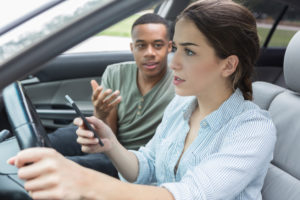
Your first hours shape the rest of your case. Here’s what protects you.
Call 911 and get the crash on the record
Ask for an officer. The report documents the scene and notes whether the other driver was on a phone. Baltimore Police body-worn camera video can capture that officer’s first impressions, and both become early proof of fault.
Get checked out, even if you feel fine
Distracted-driving crashes cause delayed injuries. Whiplash, soft-tissue damage, and concussions often don’t show up until the next day.
Save the evidence before it disappears
Photograph both vehicles, the road, and any nearby businesses with cameras. Your own dash-cam footage matters. So does the other driver’s, which we can get later through litigation.
Say very little to the insurance company
You can tell your own insurer about vehicle repair. Don’t give a recorded statement, and don’t describe how the crash happened or how you feel. One offhand sentence can be turned into an argument that you were partly at fault. Call a lawyer first.
Injured, Hon? We can help.
Free consultation. You pay nothing unless we win.
How WGK Personal Injury Lawyers Builds Your Baltimore Case
We don’t just open a file and wait for an offer. Proving distraction takes real investigative work, and here’s what we do:
- Send preservation letters before nearby camera footage is erased.
- Pull the police report and any handheld or texting citation.
- Subpoena the at-fault driver’s cellphone records once suit is filed.
- Canvass nearby businesses and intersections for video.
- Gather your medical records and bills and document your lost income.
- Build and send the demand package, then negotiate with the adjuster.
- File suit and take the case to a Baltimore jury when the offer stays too low.
That last step is why insurers take us seriously. Some carriers deny liability even on clear-fault crashes and undercut billed medical charges, which often forces a lawsuit to get fair value. We prepare every case as if a jury will decide it, and that’s what moves the insurer’s number.
Our office sits in downtown Baltimore, minutes from the courthouses where city injury cases are filed. Most of your case can be handled by phone. Documents are signed remotely, and we mail your settlement payment once the case is resolved.
WGK Personal Injury Lawyers has served injured Marylanders for nearly 50 years. Our attorneys bring nearly 100 years of combined attorney experience. The firm has recovered over $100 million for our clients.
The case results described on this website are specific to the facts and legal circumstances of each individual matter and should not be taken as a representation, promise, or guarantee that you will achieve a similar result. Prior results do not guarantee or predict a similar outcome in any future case. Every case is different and must be evaluated on its own merits. The amounts shown reflect gross recoveries before the deduction of attorneys’ fees, costs, and expenses. This website is attorney advertising.
Call (410) 837-2144 to talk through your distracted-driving case today.
This is marketing material and is not legal advice. Every case is unique and laws change frequently. Please contact our office to speak with an attorney about your specific situation before making any legal decisions.
How We Prove the Other Driver Was Distracted
Distraction is provable, but the proof has a short shelf life. Business and intersection cameras overwrite in days. Phone records need a lawsuit to reach.
The evidence that wins these cases includes:
- The citation. A handheld or texting ticket written at the scene is corroboration you get for free.
- Cellphone records. Once a suit is filed, call and data logs can show what the driver was doing at the time of impact.
- Video. Dash cams, business cameras, and city intersection cameras near the crash.
- The police report and body-worn camera. The officer’s notes and the driver’s own statements at the scene.
- Witnesses. Passengers and other drivers who saw the phone in the driver’s hand.
- Vehicle data. Braking and speed information showing a late reaction or no reaction at all.
We move to preserve the perishable items first. That’s why calling early matters more in a distracted-driving case than in almost any other crash claim.
What Your Distracted-Driving Case Is Worth
No lawyer can quote you a number in the first phone call. What we can do is explain what affects the value of your claim, so you know what the adjuster is weighing.
Medical bills and future care
Emergency treatment, imaging, therapy, injections, and surgery all count. So does care you’ll still need years from now.
Lost wages and earning capacity
Missed paychecks are the obvious part. The bigger piece is often what you can no longer earn if the injury limits the work you can do.
Permanent injury and disability
Permanent impairment, scarring, and long-term limits on daily activity raise the value of your claim substantially.
Your age and life expectancy
A younger client living with a permanent injury carries those losses for decades, and the claim should reflect that.
Pain and the way the injury changed your life
Sleep, mobility, time with your kids, and the things you can’t do anymore are compensable losses, not extras.
Gaps in treatment
Maryland expects you to mitigate your damages. If you skip appointments or stop treating, the insurance company will argue you made your own injuries worse. Keep going to your healthcare providers.
Maryland’s Distracted-Driving Laws and Your Case
Distracted driving is any activity that pulls a driver’s attention off the road, from texting and handheld phone use to eating or adjusting a GPS. Maryland takes the phone version seriously, which helps your injury claim.
Maryland Transportation Code Section 21-1124.2 prohibits a driver from using a handheld phone while the vehicle is moving, except to start or end a call. Fines run up to $75 for a first offense, $125 for a second, and $175 for a third.1 A companion statute, Section 21-1124.1, separately prohibits writing, sending, or reading a text or other electronic message while driving.2
Both are primary offenses. That means an officer can stop and ticket a driver for the phone violation alone, without any other violation. For your claim, a citation written at the scene is corroborating evidence of distraction before your case even begins.1
When distraction causes serious harm, the stakes climb. Jake’s Law is a Maryland statute, in effect since 2014, that makes it a misdemeanor to cause a serious injury or fatal crash while using a handheld device. Penalties include up to 1 year in jail and a $5,000 fine.3
It’s named for a young child killed by a distracted driver in Maryland. A criminal citation doesn’t decide your civil case, but it’s powerful proof of fault.
Maryland’s Contributory Negligence Rule
Maryland follows pure contributory negligence. If the defense proves you shared any part of the blame for the crash, however small, you can recover nothing. Nearby D.C. and Virginia apply the same standard.
That’s why the insurance company works so hard to find a sliver of fault on your side. It doesn’t need to prove you caused the crash. It only needs a jury to believe you contributed to it.
Being careless isn’t the same as contributing to causing the crash or the injuries. Our Baltimore car accident lawyer hub covers how the rule applies to other crash types.
Where Distracted-Driving Crashes Happen in Baltimore
Most Baltimore crashes cluster on a small number of streets. Over 50% of the city’s fatal and serious-injury crashes happen on just 7 percent of its roadways, the set the Baltimore City Department of Transportation calls the High Injury Network.4
Pennsylvania Avenue in West Baltimore scores worst on that network, with North Avenue close behind. Orleans Street, Pratt Street, Belair Road, and MLK Boulevard also rank among the city’s worst roads for severe crashes.4 These are stop-and-go, signalized streets where a delayed reaction becomes a rear-end or turning collision.
Baltimore’s arterials are only about 19 percent of the street network, yet they account for 82 percent of traffic fatalities and 97 percent of fatal pedestrian crashes.5 That data doesn’t change what an adjuster offers on day one. Adjusters look at speed, roadway complexity, and injury severity. Where it earns its keep is at trial, where it helps a jury understand why a crash on a known-dangerous street produced the injuries you’re living with.
We regularly handle crashes on Pratt Street, Reisterstown Road, Liberty Heights Avenue, MLK Boulevard, and Pulaski Highway.
Common Distracted-Driving Crashes We Handle in Baltimore
Distraction doesn’t cause random crashes. It produces a short list of predictable ones, and rear-end and lane-change collisions sit at the top because they stem directly from delayed reaction.
The crash types we handle across Baltimore include:
- Rear-end collisions, the signature distracted-driving crash, where a driver looks up too late to stop.
- Speeding-related crashes, where a distracted driver fails to slow for stopped or merging traffic.
- Bicycle crashes on dense city streets, where one phone glance means a rider never gets seen.
- Catastrophic-injury crashes and traumatic brain injuries, the worst outcomes from high-speed inattention.
Our cases cover the full injury range, from soft-tissue and back and neck injuries through life-altering brain and spinal-cord trauma. If your crash type isn’t listed here, call us, and we’ll tell you whether we can help.
Your Case in Baltimore City Court
Where your case is filed depends on the dollar value involved. Claims seeking $30,000 or less are generally heard in the District Court of Maryland for Baltimore City, a faster bench trial before a judge.6 Larger claims go to the Circuit Court for Baltimore City at the Clarence M.
Mitchell, Jr. Courthouse, where a jury hears the case.7
Venue isn’t a free choice in Maryland. You can file where the crash happened or where the at-fault driver lives, not simply in the county you’d prefer. For a Baltimore City crash, that usually keeps your case in Baltimore City.
If your case is in the Circuit Court for Baltimore City, the court may order mediation before trial. If it does, both sides attend, and many of those sessions end without a settlement. Your case doesn’t lose value because mediation didn’t resolve it.
Medical Care After a Baltimore Crash
Prompt, documented treatment protects both your health and your claim. Gaps give the insurance company an opening to argue your injuries weren’t caused by the crash.
Most Baltimore crash victims who need emergency care are seen at hospitals like Sinai Hospital in Northwest Baltimore or Mercy Medical Center downtown, or at an urgent-care clinic such as Patient First for less severe injuries. For catastrophic harm, the destination is the R Adams Cowley Shock Trauma Center on South Greene Street, Maryland’s highest-level trauma center. Johns Hopkins Bayview Medical Center is a Level II trauma center serving Southeast Baltimore.
Whichever provider you see, tell them about every symptom and keep every follow-up appointment. Your records are the backbone of your damages claim.
Frequently Asked Questions
Is texting and driving illegal in Baltimore?
Yes. Maryland law prohibits writing, sending, or reading a text or electronic message while driving, and separately bars handheld phone use while the vehicle is moving.2 Both are primary offenses, so a Baltimore officer can stop and ticket a driver for the phone violation alone, with no other infraction needed.1 Fines start at $75 for a first handheld offense.1
How much is my distracted-driving case worth?
It depends on your medical bills, how long your recovery takes, the wages and earning capacity you lose, and whether the injury is permanent. Your age matters too, because a permanent injury at 30 years of age costs you more over a lifetime than the same injury at 70. Gaps in treatment lower value, so keep seeing your healthcare providers. Any Baltimore distracted driving attorney who quotes you a number before reviewing your records is guessing.
How much does it cost to hire a Baltimore distracted-driving lawyer?
There’s no upfront cost. We work on contingency: 33.3% of the gross recovery if your case resolves before a lawsuit is filed, and 40% once a lawsuit is filed, whether or not the case goes to trial. When there is a recovery, the case costs we advanced are reimbursed to us out of the gross settlement. If there is no recovery, you owe no fee and no costs.
How long do I have to file a distracted-driving lawsuit after a Baltimore crash?
Maryland’s general personal injury deadline is 3 years from the date of the accident. The clock runs from the crash, not from when your symptoms appear. If a city or government vehicle was involved, you must give written notice within 1 year under the Local Government Tort Claims Act, which is much sooner than the 3-year window. Miss either deadline and your claim is gone.
Can I still recover if the insurer says I was also on my phone?
Maybe. Being careless isn’t the same as contributing to causing the crash or the injuries.
What types of distraction count besides texting?
Federal safety researchers group driving distractions into three categories: visual (eyes off the road), manual (hands off the wheel), and cognitive (mind off the task). Texting is uniquely dangerous because it engages all three at once.8 Eating, adjusting a GPS, reaching into the back seat, and talking with passengers are all recognized forms of distracted driving.
Schedule a Free Consultation With a Baltimore Distracted-Driving Lawyer
If a distracted driver hurt you in Baltimore, the next step is one phone call. When there is a recovery, the case costs we advanced are reimbursed to us out of the gross settlement. If there is no recovery, you owe no fee and no costs.
For nearly 50 years, WGK Personal Injury Lawyers has fought for injured people across Baltimore.
Call our Baltimore office at (410) 837-2144 or reach us through our Baltimore car accident lawyer page to get started today.
Related Practice Areas
- Baltimore Car Accident Lawyer: our main hub for every type of Baltimore crash claim.
- Drunk Driving Accidents: impaired-driver crashes and the evidence that proves them.
- Self-Driving Car Accidents: liability when automation and driver inattention overlap.
- Car Accident Statistics: the data behind Baltimore crash claims.
- Car Accident Liability: how fault is proven in Maryland.
- Dundalk Distracted Driving Accidents: distracted-driving help in Baltimore County.
Sources
- Maryland General Assembly, Statute Text § 21-1124.2 (Communications Traffic Safety Act), 2024. Handheld phone prohibition, fine schedule ($75/$125/$175), and primary-offense status. https://mgaleg.maryland.gov/mgawebsite/Laws/StatuteText?article=gtr§ion=21-1124.2
- Maryland General Assembly, Statute Text § 21-1124.1 (Text Messaging Prohibited), 2024. Prohibition on writing, sending, or reading a text or electronic message while driving. https://mgaleg.maryland.gov/mgawebsite/Laws/StatuteText?article=gtr§ion=21-1124.1
- End Distracted Driving (Casey Feldman Foundation), 2014. Jake’s Law effective date, misdemeanor framework, and up to one year jail / $5,000 fine. https://www.enddd.org/the-impact/jake-owen-5-md/
- Baltimore Banner, citing Baltimore City Department of Transportation High Injury Network analysis, 2024. more than half of fatal and serious-injury crashes on 7 percent of roadways; Pennsylvania Avenue and North Avenue worst-scoring corridors; Orleans, Pratt, Belair, and MLK among worst. https://www.thebanner.com/community/transportation/baltimore-crash-accidents-car-pedestrians-roads-W6C72ZN4ZJDWXNFXSD56CP7XXU/
- Baltimore City Strategic Highway Safety Plan (via Zero Deaths Maryland), 2022. Arterials are 19 percent of the network but account for 82 percent of fatalities and 97 percent of fatal pedestrian crashes. https://zerodeathsmd.gov/wp-content/uploads/2022/05/Baltimore-City-SHSP.pdf
- Maryland General Assembly, Statute Text Courts and Judicial Proceedings § 4-401, 2024. District Court exclusive civil jurisdiction up to $30,000. https://mgaleg.maryland.gov/mgawebsite/Laws/StatuteText?article=gcj§ion=4-401
- Circuit Court for Baltimore City, Court Directory, 2026. Clarence M. Mitchell, Jr. Courthouse, 100 N. Calvert Street. https://baltimorecitycourt.org/general-information/court-directory/
- National Highway Traffic Safety Administration (NHTSA), Countermeasures That Work: Distracted Driving. Three categories of driver distraction (visual, manual, cognitive) and texting as a behavior that combines all three. https://www.nhtsa.gov/book/countermeasures-that-work/distracted-driving