





A driver hit you while you were on foot. Now the medical bills are stacking up, you’re missing work, and an adjuster has already called about a statement. You may have the right to be paid for all of it.
A pedestrian accident settlement is a negotiated payment that compensates an injured pedestrian without a trial. The money can come from the at-fault driver’s liability insurer, from your own uninsured or underinsured motorist coverage, or from a state fund. What your case is worth depends on your bills, your recovery, your lost income, and how clearly fault can be attributed. It’s never a fixed number.
Talk with a Maryland pedestrian accident lawyer at WGK Personal Injury Lawyers. The consultation is free, and you pay nothing unless we recover compensation for you. Call (410) 837-2144.
Table of Contents
What WGK Does for Your Pedestrian Accident Settlement
We build the case the insurance company hopes you can’t. A driver’s insurer will blame the pedestrian, undercut the medical bills, and wait for you to get tired. Our job is to take that strategy apart.
Here’s what that looks like in practice:
- We send preservation letters so nearby business and traffic camera footage isn’t erased.
- We request light-sequencing data and any body-worn camera video from the responding officers.
- We collect your records and bills and document how the injury has changed your daily life.
- We build a demand the insurer has to take seriously, then negotiate it.
- If they won’t pay fair value, we file suit and take the case to a Maryland jury.
We’ve recovered over $100 million for our clients.
Past results do not guarantee future outcomes. Every case is different. These figures represent aggregated data from cases handled by our firm and are provided for informational purposes only.
Hundreds of injured Marylanders turn to us every year, and we’ve obtained numerous six- and seven-figure settlements. Pedestrian cases sit inside our broader auto caseload. We don’t track them as a separate average, so be careful with any firm that promises you a “typical pedestrian settlement” number.
Injured, Hon? We can help.
Free consultation. You pay nothing unless we win.
What Drives the Value of Your Pedestrian Accident Settlement
There’s no single average pedestrian settlement, and any number sold as one should make you suspicious. Value is built from your own facts. Here’s what actually moves it.
Your medical bills
Your treatment costs are the foundation of the claim. Emergency care, imaging, surgery, follow-up visits, and physical therapy all count. The care you’ll still need after the case ends also adds to your costs, when a doctor can say what that care will be. Bigger, better-documented treatment means a bigger number.
How long your recovery takes
A pedestrian struck at speed rarely walks away in 2 weeks. The longer your documented recovery runs, the more the claim is worth, because the record shows a real disruption instead of a bruise. Insurers read short treatment as a minor injury, whether or not that’s true.
Lost wages and earning capacity
You can claim the pay you lost while you were out. If the injury pushes you into lighter work, fewer hours, or a different job entirely, the lost future earning capacity is part of the claim too. Pay stubs, tax records, and a treating doctor’s work restrictions carry this piece.
Permanent injury and disability
Permanency raises value more than almost anything else. A fracture that heals cleanly is one case. A joint that never fully works again, a spinal injury, or a head injury with lasting effects is another. What matters is what you can no longer do, at work and at home.
Your age and life expectancy
Age cuts both ways. A permanent injury to a younger client carries more years of consequence, which raises value. Older clients often heal slower and face longer recoveries, which also affects what a case is worth. Among people 65 and older killed in traffic, 19% were pedestrians.1
Gaps in your treatment
Treatment timing matters more than most people realize. Insurers start reducing the case value when initial treatment is delayed by 3 to 5 days. A gap of 10 to 14 days or longer can threaten the claim itself. If you stop going, the insurer argues you got better, and that argument is hard to unwind later.
Available insurance and how clear fault is
You can only recover what someone can actually pay. A clear-liability crash with a large commercial policy and months of documented treatment looks nothing like a disputed crash on a state-minimum policy. Finding every applicable policy is part of the value work, not just paperwork.
Whether a lawsuit gets filed
Some insurers don’t pay fair value until they’re in front of a judge. Filing changes the pressure, opens formal discovery, and puts a trial date on the calendar. Our Maryland car accident claims process page walks through how a claim moves from intake to resolution.
When to Call a Pedestrian Accident Lawyer
Call before you talk to the driver’s insurance company. The first 24 to 48 hours shape your case. One recorded statement can give the insurer a contributory negligence argument you didn’t see coming.
Reach out right away if you were:
- Hit in a crosswalk or by a turning car
- Struck by a hit-and-run or uninsured driver
- Hurt badly enough to need an emergency room
- Already contacted by an adjuster with a quick offer
Early offers tend to land below what your treatment will actually cost. Once you sign a release, that’s the end of the claim.
What to Do After You’re Hit as a Pedestrian
The steps you take in the first few days can decide whether your claim holds up.
- Call 911 and get an officer to the scene. The police report and any body-worn camera footage are key liability evidence, and both are far harder to recover later.
- Photograph everything you can. The scene, the vehicle, the spot where you were hit, and your injuries. Get names and numbers for witnesses.
- Get medical care quickly, even if you feel “okay.” Adrenaline hides injuries. A concussion or soft-tissue injury may not surface for a day or two. Prompt treatment also ties your injuries to the crash.
- Don’t give the driver’s insurer a recorded statement. And don’t guess about fault at the scene. A reflexive “I didn’t see them either” gets turned into a contributory negligence defense by the insurance company’s representative.
- Call a lawyer first. Let someone else handle the adjuster while you treat.
Why Pedestrian Crashes Happen, and Why It Matters to Your Claim
Most pedestrian crashes come down to a driver who wasn’t paying attention. That matters to you because the same facts that explain the crash are the facts that establish liability.
Visibility is the big one. In recent national reporting, 77% of pedestrian deaths happened in the dark, 74% happened away from intersections, and 84% happened in urban areas.1 Those numbers cut against the “they came out of nowhere” defense more often than insurers admit.
Impairment and speed show up again and again. Alcohol was involved, on the driver’s side or the pedestrian’s, in 46% of fatal pedestrian crashes.1 Speeding is a known factor in a meaningful share of pedestrian deaths.2 Both are driver-conduct problems, and both help prove fault.
Then there are the drivers who leave. About 24% of pedestrians killed were struck by hit-and-run drivers, and 89% of pedestrian deaths involved a single vehicle.1 A driver who flees doesn’t end your claim. We explain the coverage that steps in below.
Maryland isn’t a safe place to be on foot, which is part of why these cases get fought so hard. Across the most recent 5-year period, the state averaged about 135 pedestrian deaths and roughly 2,700 pedestrian injuries a year.3 Maryland’s pedestrian death rate also runs higher than the national average.2
Types of Pedestrian Cases We Handle
Pedestrian claims aren’t all the same, and the dispute is rarely identical from one crash to the next.
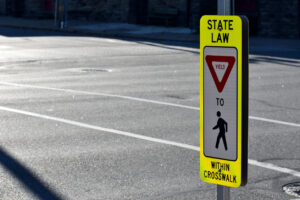
Crosswalk and intersection crashes are the most common. Maryland Transportation § 21-502 requires a driver to stop for a pedestrian crossing in a crosswalk on the driver’s half of the road. It also bars passing a vehicle that has stopped for a walker, and it says a pedestrian may not suddenly step off a curb into the path of a car that’s too close to yield.4 A driver who turns through a crosswalk into someone with the right of way is usually at fault.
Hit-and-run and uninsured-driver crashes need a different playbook. When the driver flees or carries no coverage, we look to your own auto policy and to the state fund described below. Our hit and run accident team handles those daily.
Driver-behavior crashes round out the list. Distracted driving, speeding, and drunk driving all feed pedestrian injuries, and each opens a clear liability theory. Riders hurt in similar ways can turn to our bicycle accident and electric scooter accident attorneys.
Who Can Be Held Liable
The at-fault driver is the starting point, not always the only target. Finding every responsible party is how we find the insurance coverage that actually pays your bills.
A driver who failed to yield, ran a light, or sped through a crosswalk is the most common defendant. If that driver was working at the time, in a delivery van or a commercial vehicle, the employer’s policy may be on the hook too. Larger policies usually mean bigger fights, so the work of finding and preserving the evidence matters even more.
Government and property owners can also be liable. A crash with a city, county, or state vehicle brings special deadlines, covered below. When a broken sidewalk or a hazard on private land contributes to the injury, a property owner may share responsibility. We sort out which policies apply so nothing that could pay your claim gets missed.
Damages You Can Recover in a Pedestrian Accident Case
You can recover for what the crash cost you and for what it took from your daily life. Maryland splits this into economic and non-economic damages.
Economic damages are the bills with a number on them: medical care, lost wages, and other direct financial costs of the injury. These have no statutory limit.
Non-economic damages cover pain and suffering. That includes the physical pain and the limits the injury puts on your daily life, the activities you can’t do anymore, and the routine tasks that have become hard.
Property damage is a separate matter. Repairing or replacing your phone, clothing, or other belongings is handled apart from the injury claim and doesn’t add to your bodily-injury recovery. WGK generally doesn’t handle the property-damage side of a claim, with the one exception of diminished-value claims.
A word of caution on extras. Things like in-home help or rides to appointments aren’t reliably paid as standalone damages in Maryland, and insurers push back on them, so we don’t promise recovery on those line items.
Maryland Law: Fault, Deadlines, and the Damages Cap
Three Maryland rules shape almost every pedestrian settlement: how fault works, how long you have, and how much pain-and-suffering money is allowed. Getting these right early can save your case.
Pure contributory negligence
Maryland follows pure contributory negligence. If you’re found even 1% at fault for the crash, you can be barred from recovering anything.5 Maryland is one of a small group of jurisdictions, along with the District of Columbia and Virginia, that still applies this rule. That’s exactly why insurers reach for jaywalking and dark-clothing arguments in pedestrian cases.
Two doctrines that fight back
Under Maryland’s Myers v. Bright, being negligent isn’t the same as being contributorily negligent. Your carelessness has to have actually caused the collision, so crossing outside a crosswalk doesn’t automatically end your claim.
Last clear chance is the other key tool. If the driver had a real, final chance to avoid hitting you and didn’t take it, you may recover even if you were partly at fault. Picture a pedestrian who has already crossed 4 of 6 lanes in broad daylight when a driver trying to beat a red light strikes her. The last clear chance argument defeats the jaywalking defense in that case.
This is marketing material and is not legal advice. Every case is unique and laws change frequently. Please contact our office to speak with an attorney about your specific situation before making any legal decisions.
Your deadlines
Maryland gives you 3 years from the date of the accident to file most personal injury lawsuits.6 The discovery rule doesn’t stretch that deadline for a pedestrian case, because the injury is obvious the day it happens, so the clock runs from the crash date.
If a city, county, or state government vehicle hit you, written notice must be filed far sooner, generally within 1 year. Those claims also face statutory damage limits and special procedural rules that change how the case is valued.
The cap on pain-and-suffering damages
Maryland caps non-economic damages in every personal injury case, including pedestrian and wrongful death claims, not just medical malpractice. For accidents occurring on or after October 1, 2025, the cap is $965,000 per injured person, and it rises $15,000 each October 1.7 In a wrongful death case with 2 or more eligible beneficiaries, the cap increases to $1,447,500. The cap that applies is set by the date of your accident, not the date you file suit.
How Insurance Works After a Pedestrian Accident
A pedestrian crash usually has more than one source of money, and the order matters. We work the layers so you reach the coverage that can actually pay.
The at-fault driver’s liability policy
This comes first. Maryland’s minimum required auto policy is just $30,000 per person and $60,000 per accident, which often fall short for serious injuries.
Your own UM/UIM coverage
If the driver was uninsured or fled, you may recover under the uninsured or underinsured motorist coverage on your own or a household member’s auto policy, even though you were on foot. Maryland requires UM/UIM coverage on every auto policy. You can only tap UIM after the driver’s liability policy is paid out in full. Enhanced UIM (EUIM) stacks on top of the driver’s policy instead of being offset against it.
A quick example shows why the type matters. Say the driver carries the $30,000 state minimum and you carry $100,000 in UIM. With standard UIM, your policy is offset, so you collect up to $70,000 on top of the driver’s $30,000, for a total of $100,000. With enhanced UIM, there’s no offset, so your full $100,000 stacks on top of the driver’s $30,000, for up to $130,000.
The Unsatisfied Claim and Judgment Fund
When there’s no policy at all, the state fund steps in. Maryland’s Unsatisfied Claim and Judgment Fund is a state program that pays up to $30,000 per person to pedestrians and passengers struck by an uninsured driver with no household auto policy. The Fund doesn’t cover the uninsured driver, and it requires a Notice of Claim within 180 days of the crash.8
PIP, your own no-fault medical coverage
Personal injury protection, or PIP, is a no-fault benefit that pays your medical bills and lost wages up to your policy limit, usually $2,500, no matter who caused the crash. PIP comes on Maryland auto policies unless it’s waived in writing, because insurance companies must offer it. Your insurer can’t take it back out of your settlement, so you keep it on top of any recovery from the driver.
Some insurers are harder than others.
Certain carriers deny liability even on clear-fault crashes, undercut billed medical charges, and won’t pay real value until a lawsuit is filed. That behavior isn’t a reason to accept less. It’s a reason to document the claim tightly from day one and to be ready to file.
This is marketing material and is not legal advice. Every case is unique and laws change frequently. Please contact our office to speak with an attorney about your specific situation before making any legal decisions.
What a Pedestrian Accident Lawyer Costs
Nothing up front. We work on contingency, so our fee comes out of the recovery, not your pocket.
The standard Maryland contingency fee is 33.3% if your case resolves before a lawsuit. The fee increases to 40% once a lawsuit is filed, whether or not the case goes to trial. Claims against the State under the Maryland Tort Claims Act are subject to statutory fee caps of 20% of a settlement or 25% of a judgment. We advance case costs, and you pay nothing unless we recover compensation for you.
Frequently Asked Questions
What is the average pedestrian accident settlement in Maryland?
There’s no reliable average. Settlement value depends on the available insurance, how clear fault is, your injuries and treatment, your lost wages, the number of people hurt, and whether suit is filed. Any firm quoting a single “typical” pedestrian number is guessing. We give you a grounded read after reviewing your specific facts.
How long do I have to file a Maryland pedestrian accident claim?
Generally, 3 years from the date of the accident for most personal injury lawsuits.6 Two deadlines run much shorter. A claim involving a government vehicle requires written notice, generally within 1 year.
A claim with the state’s uninsured-driver fund requires a Notice of Claim to be filed within 180 days.8 Call early so no deadline slips.
Can I still recover if I was jaywalking or crossed against the signal?
Possibly. Maryland’s pure contributory negligence rule is unforgiving: 1% of fault can bar recovery. But being negligent isn’t automatically fatal to your claim.
Under Myers v. Bright, your conduct has to have actually caused the crash, and last clear chance can still apply if the driver had a real chance to avoid you. These cases are fact-specific, so get your case facts reviewed.
What if the driver who hit me had no insurance or fled the scene?
You still have paths to recovery. You may collect under the uninsured or underinsured motorist coverage on your own or a household member’s auto policy, even though you were walking. If no household policy exists, Maryland’s Unsatisfied Claim and Judgment Fund can pay up to $30,000 per person. The Fund doesn’t cover the uninsured driver and has a 180-day notice deadline.
Does Maryland cap what I can recover for a pedestrian injury?
Maryland caps non-economic damages, like pain and suffering, in every personal injury case, including pedestrian claims. For accidents on or after October 1, 2025, the cap is $965,000 per injured person, and it rises each October 1.7 The cap is set by your accident date, not your filing date. Economic damages such as medical bills and lost wages have no statutory limit.
What damages can I recover after a pedestrian crash?
Economic damages cover your medical bills, lost wages, and other direct costs of the injury, with no statutory limit. Non-economic damages cover pain and suffering, which includes both physical pain and the limits the injury puts on your daily life. Property damage is handled separately and isn’t part of your injury recovery.
How is fault proven in a pedestrian accident?
Fault is built from evidence, not arguments. We rely on the police report, witness statements, footage from nearby businesses and body-worn cameras, light-sequencing data at signalized intersections, and photos of the scene and the vehicle. Most of that evidence has a short shelf life. The sooner it’s gathered and preserved, the harder it is for the insurer to rewrite what happened.
What if I was hit in a parking lot or on private property?
You may still have a claim. Drivers owe pedestrians ordinary care everywhere they operate, and crosswalk and right-of-way duties can apply in lots and on private roads. These cases turn on specific facts like speed, visibility, and who had the right of way. Have the details reviewed before you assume the location is a problem.
How long does a pedestrian accident case take?
Most straightforward cases resolve in roughly 4 to 9 months before suit is filed. The main drivers are how long your treatment lasts and how the insurer responds. Cases with serious injuries or surgery take longer, because we can’t value the claim until your doctors know where you’ll end up. If we file suit, add roughly 12 to 24 months for the court process.
Should I give the insurance company a recorded statement?
No, not before you talk to a lawyer. Adjusters ask questions designed to pull out admissions that hurt your claim. In a contributory-negligence state, one offhand phrase about what you “should have” done can be used to deny your claim outright. Let your attorney handle communications, so your words aren’t turned against you.
Can I get PIP benefits if I was walking rather than driving?
Often, yes. Personal injury protection is a no-fault benefit that pays medical bills and lost wages up to your policy limit, usually $2,500, regardless of fault. You may be able to use PIP through your own or a household member’s auto policy even though you were on foot. Your insurer can’t take it back out of your settlement.
Schedule a Free Consultation With a Maryland Pedestrian Accident Lawyer
If a driver hit you while you were walking, the next call should be to a lawyer, not the driver’s insurance company. We’ll review what happened, explain your options, and start protecting the evidence before it’s lost.
You pay nothing unless we recover compensation for you. WGK has been representing injured Marylanders for nearly 50 years. Our attorneys bring nearly 100 years of combined attorney experience to that work.
Life fills up fast after a crash, with treatment, missed work, and insurance calls. We handle most of a case by phone, sign documents remotely, and mail your settlement payment once the case is resolved.
Call a Maryland pedestrian accident attorney now at (410) 837-2144 for your free case review.
Past results do not guarantee future outcomes. Every case is different. These figures represent aggregated data from cases handled by our firm and are provided for informational purposes only.
Related Practice Areas and Service Areas
- Baltimore Pedestrian Accident Lawyer: pedestrian claims across Baltimore City
- Maryland Pedestrian Accident Lawyer: statewide pedestrian representation
- Baltimore Car Accident Lawyer: driver and passenger injury claims
- Baltimore Truck Accident Lawyer: crashes involving commercial trucks
- Maryland Bicycle Accident Lawyer: injured cyclists
- Baltimore Electric Scooter Accident Lawyer: scooter rider injuries
- Hit and Run Accident Lawyer: fleeing and unidentified drivers
- How Car Insurance in Maryland Works: coverage basics for your claim
Scene Evidence
- Photos, video, and witness contacts
- The report number and driver information
Loss Records
- Medical bills and treatment records
- Wage and work records
Sources
- NHTSA, Traffic Safety Facts 2023 Data – Pedestrians (DOT HS 813 727), 2023. National pedestrian fatality and injury counts, share of all traffic deaths, dark/non-intersection/urban crash characteristics, alcohol involvement, hit-and-run and single-vehicle shares, and age data. https://crashstats.nhtsa.dot.gov/Api/Public/ViewPublication/813727
- Governors Highway Safety Association (GHSA), Pedestrian Traffic Fatalities by State – 2024 Preliminary Data, 2024. Speeding as a factor in pedestrian deaths and Maryland’s per-capita pedestrian fatality rate relative to the national rate. https://www.ghsa.org/sites/default/files/2025-07/Pedestrian%20Traffic%20Fatalities%20by%20State%20-%202024%20Data%20-%207.10.25.pdf
- Zero Deaths Maryland (MDOT Maryland Highway Safety Office), Crash Data for Maryland, 2019-2023. Maryland five-year average pedestrian deaths and injuries. https://zerodeathsmd.gov/resources/crashdata/
- Maryland General Assembly, Md. Code, Transportation § 21-502, 2024. Driver duty to stop for pedestrians in a crosswalk, prohibition on passing a stopped vehicle, and the pedestrian sudden-departure limit. https://mgaleg.maryland.gov/mgawebsite/Laws/StatuteText?article=gtr§ion=21-502&enactments=false
- Insurance Journal, Commentary: Contributory Negligence Remains the Law in Maryland, 2013. Corroboration of Maryland’s pure contributory negligence rule (Coleman v. Soccer Ass’n of Columbia, 432 Md. 679 (2013)). https://www.insurancejournal.com/news/east/2013/08/06/300202.htm
- Maryland General Assembly, Md. Code, Cts. & Jud. Proc. § 5-101, 2024. Three-year statute of limitations for civil actions. https://mgaleg.maryland.gov/mgawebsite/laws/StatuteText?article=gcj§ion=5-101
- Maryland General Assembly, Md. Code, Cts. & Jud. Proc. § 11-108, 2025. Non-economic damages cap mechanism, annual $15,000 escalator, and 150% multiplier for multi-beneficiary wrongful death. https://mgaleg.maryland.gov/mgawebsite/laws/StatuteText?article=gcj§ion=11-108
- Code of Maryland Regulations (COMAR) 14.07.04.04, 2026. Unsatisfied Claim and Judgment Fund Notice of Claim 180-day deadline and eligibility. https://regs.maryland.gov/us/md/exec/comar/14.07.04.04